This work has not been peer reviewed by the University of the Philippines Rainbow Research Hub or its project members. The views expressed are solely those of the author(s) and do not necessarily reflect those of the Hub or its project members.
2026 Philippine Queer Studies Conference
POSTER PRESENTATION
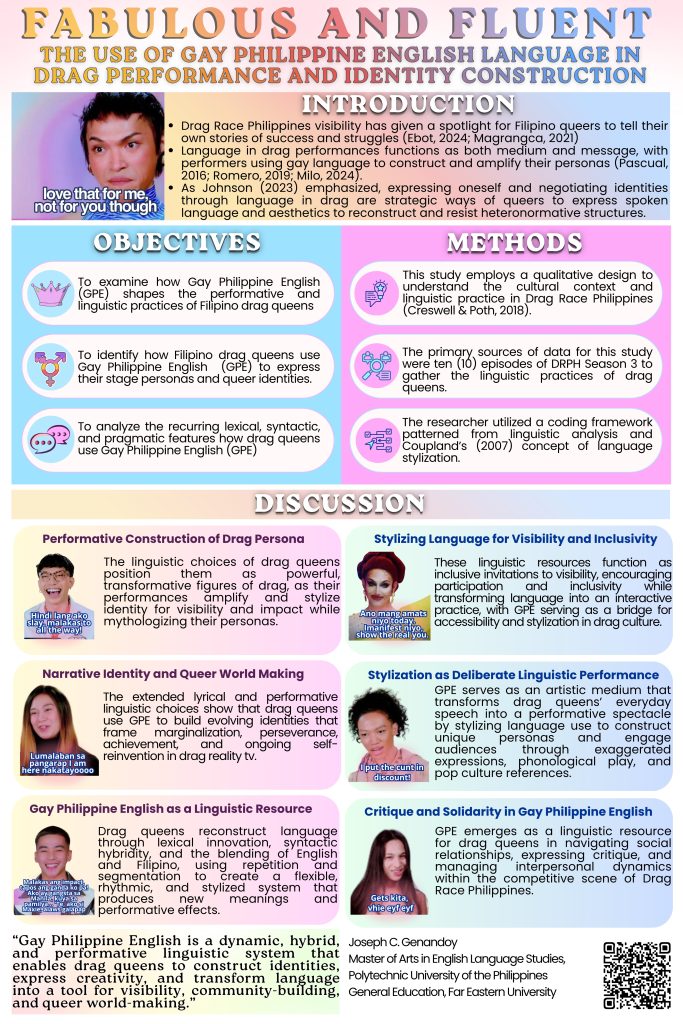
Fabulous and fluent: The use of gay Philippine English in drag performance
Joseph C. Genandoy
This study explores how Filipino drag queens utilize Gay Philippine English (GPE) to construct stage persona and express queer identities. Building on Judith Butler’s (1990) theory of performativity, Nikolas Coupland’s (2007) concept of stylized language, and Queer Linguistics (Motschenbacher, 2010; Jones, 2011), this study uses a qualitative ethnographic design to gather data through participant observation, semi-structured interviews with five (5) drag queens, and linguistic analysis of ten (10) episodes of Drag Race Philippines Season 3. This multi-method approach provides this study with an in-depth examination of cultural, performative, and linguistic dimensions of GPE.
Emerging results of this study suggest that GPE is used by drag queens as a communicative tool and a stylized performance of queer identities. Drag queens use recurring lexical strategies such as affixation, pop cultural references, and creative code-switching, alongside syntactic play and pragmatic devices like irony, parody, and quotability. The linguistic choices enable queens to assert their visibility, challenge heteronormative norms, and establish solidarity and community with their audience. This study affirms GPE as a unique linguistic variety that is performative and strategically shaped by the queerness of drag queens and Philippine pop culture. This research contributes to the growing field of queer linguistics and Gay Philippine English by highlighting the performative and resistant use of language in Filipino drag performance.