This work has not been peer reviewed by the University of the Philippines Rainbow Research Hub or its project members. The views expressed are solely those of the author(s) and do not necessarily reflect those of the Hub or its project members.
2026 Philippine Queer Studies Conference
POSTER PRESENTATION
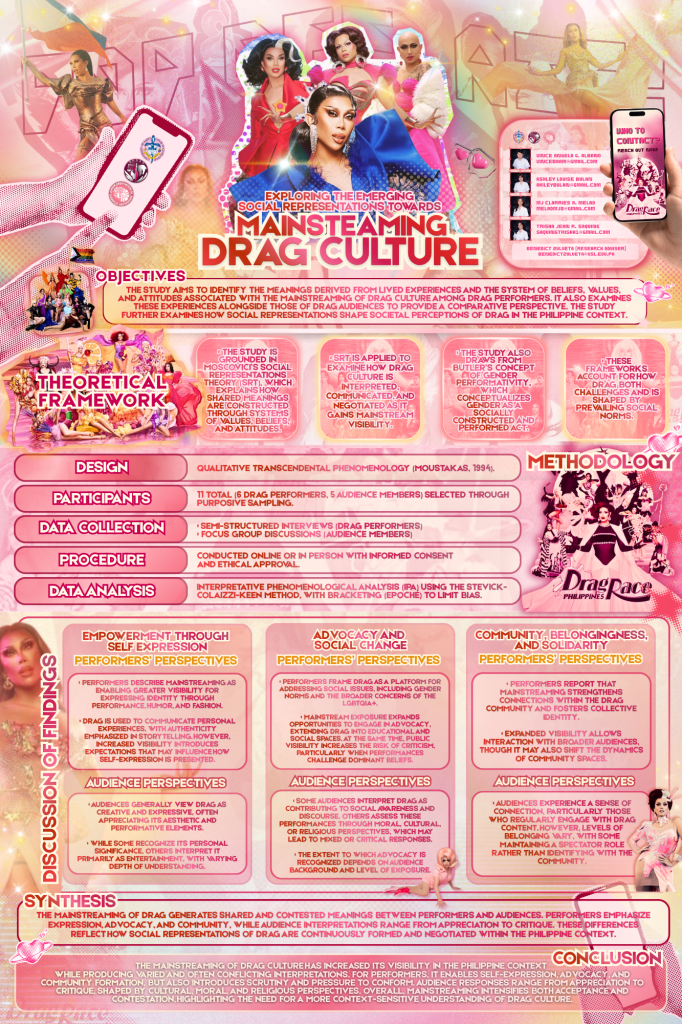
Exploring the social representations of mainstreaming drag culture
Vincent Angelo G. Albano, MJ Clarries Melad, Trisha Jean Saquing, and Ashley Louise Bulan
Drag is a uniquely ubiquitous term, encompassing a wide range of definitions such as an artistic expression, a political statement, or a legitimate career. Over time, drag has continued to become mainstream and penetrate various facets of society; the study investigates these evolving societal perceptions of drag as it gains mainstream recognition, particularly in the Philippines. Historically, a subversive performative art, drag’s increased media visibility has sparked broader public discourse. Grounded in Moscovici’s social representations theory, the research explores how individuals perceive drag’s mainstreaming and how these experiences are articulated through systems of beliefs, values, and attitudes. Employing a qualitative transcendental phenomenology approach, this study explored the lived experiences of six Filipino drag performers who have been performing in drag for at least a year and five drag audience members who regularly watch drag either in person or through digital platforms, all selected through a purposive sampling technique from various locations around the Philippines. Data was gathered through semi-structured interviews and focused group discussions, then analyzed using Interpretative Phenomenological Analysis (Stevick-Colaizzi-Keen’s method). The researchers employed Lincoln and Guba’s trustworthiness framework to increase the study’s rigor. Results show the fascinating windows into the mainstreaming phenomenon. First, mainstreaming was seen as an avenue of empowerment through self-expression, which was reflected in various drag elements, such as performances, humor, and fashion extravaganza. Drag is often presented as authentic storytelling of one’s personal experiences. Second, mainstreaming is viewed as instrumental in promoting advocacy and a move towards social change. This is seen through the challenging of heteronormative norms and the transcendence of drag from entertainment into broader social work, such as education. Third, the mainstreaming process strengthens the sense of community, belongingness, and solidarity within the drag community and among the audience and the general public, who also find watching drag a motivation. However, despite these details offering a positive light into the mainstreaming of drag, there remain poignant features that underlie the challenges and limitations faced by drag performers. These findings underscore the need for further research to understand the potential negative ramifications of mainstreaming for drag queens and audiences.