This work has not been peer reviewed by the University of the Philippines Rainbow Research Hub or its project members. The views expressed are solely those of the author(s) and do not necessarily reflect those of the Hub or its project members.
2026 Philippine Queer Studies Conference
POSTER PRESENTATION
Identity, community, and movement: On trans history in the Philippines, 1960s – present
Nikolai M. Russegger
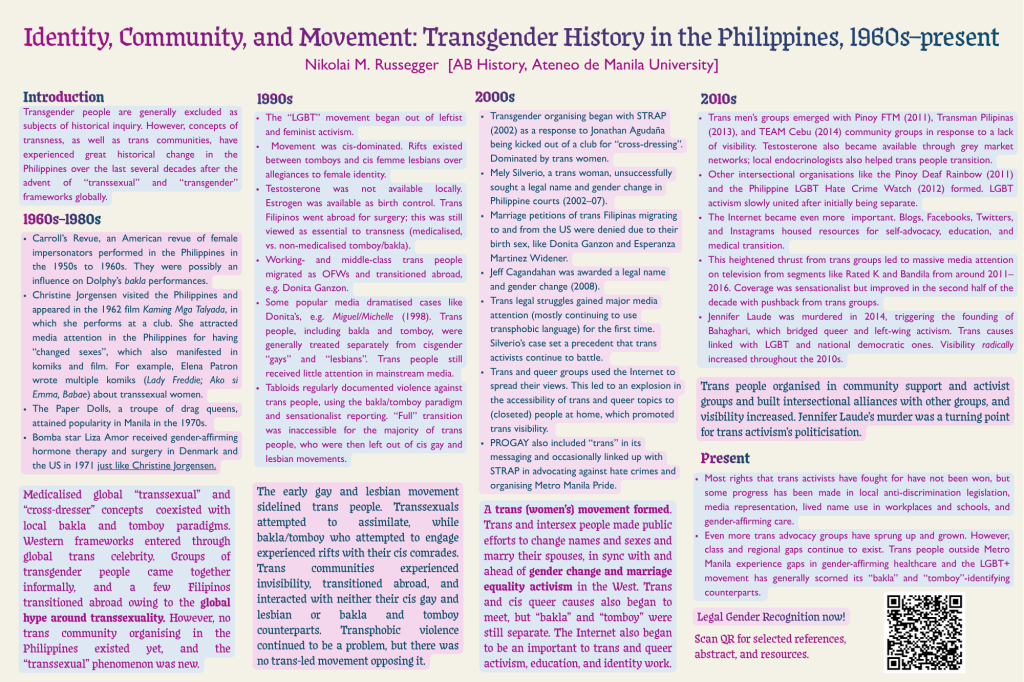
This presentation is an exploration of the histories of transgender communities and movements in the Philippines. While the trans* figure of the babaylan is occasionally referred to in the sparse existing research on Philippine queer history, little if any work exists on histories of gender variance as a concept or on transgender communities and movements themselves beyond the pre-colonial period. Thus, this presentation seeks to unearth and analyse these histories, particularly trans histories of the 1960s onward, around the time that the term “transgender” was coined and the term “transsexual” was popularised, in order to build a genealogy of present trans* movements and communities in the Philippines.
A broad variety of sources shall be used, owing to the fluid, rapidly-shifting, and global nature of trans identities and communities. These include films, such as Kaming Mga Talyada (1962), TV segments like the Balita segment on transgender men (2011), and recent Internet sources like PFTM’s Tumblr blog, inspired by Avery Dame-Griff’s US-centred transgender history of the Internet. Put together, these sources reflect a trans history that is fluid and global. Concepts of transness have interacted with those from other countries, beginning with foreign researchers on gender and sexuality doing fieldwork in the Philippines, widespread news of Christine Jorgensen’s transition in the 1950s and 60s, and transgender Filipino émigré in the 1960s and 70s, these concepts being imported to the Philippines, interacting with local concepts of gender and sexuality e.g. “bakla” and “tomboy”. Trans Filipino communities—principally transfeminine ones—would develop as close associations throughout the decades, for instance as drag groups, both at home and among Overseas Filipino Workers (OFWs).
However, transgender Filipinos have been largely left out of the narrative of the Philippines’ early gay and lesbian rights movements in the 1990s, which has focused on gender-conforming cis queer people; the presence of tomboys and transmasculine individuals in lesbian groups, for example, was a sticking point that led to the separation of these groups from the existing queer movement. As a result, transgender Filipinos formed their own movements, beginning with the transfeminine STRAP in 2002, and trans community and identity has since coalesced online and become increasingly politicised. Other transgender community groups formed in the 2000s and 2010s, including TEAM and PFTM, whose founding members often learned about their own identities or transitioned online and abroad and who spawned online presences on Tumblr and Facebook.
Trans identity and community has spread through these online blogs, as well as through mass media: news articles, TV segments, and individual thinkpieces. This history has developed online up until the 2020s—especially on account of the COVID-19 pandemic—forming transgender communities and movements as they exist now: fighting for civil rights; spreading information on transition, job safety, and education; creating trans art and media; and advocating for members of the community. Mass media, the Internet, and migration have shaped the Philippines’ constantly-shifting and relatively recent trans history, which continues to be made and to move every day.