This work has not been peer reviewed by the University of the Philippines Rainbow Research Hub or its project members. The views expressed are solely those of the author(s) and do not necessarily reflect those of the Hub or its project members.
2026 Philippine Queer Studies Conference
POSTER PRESENTATION
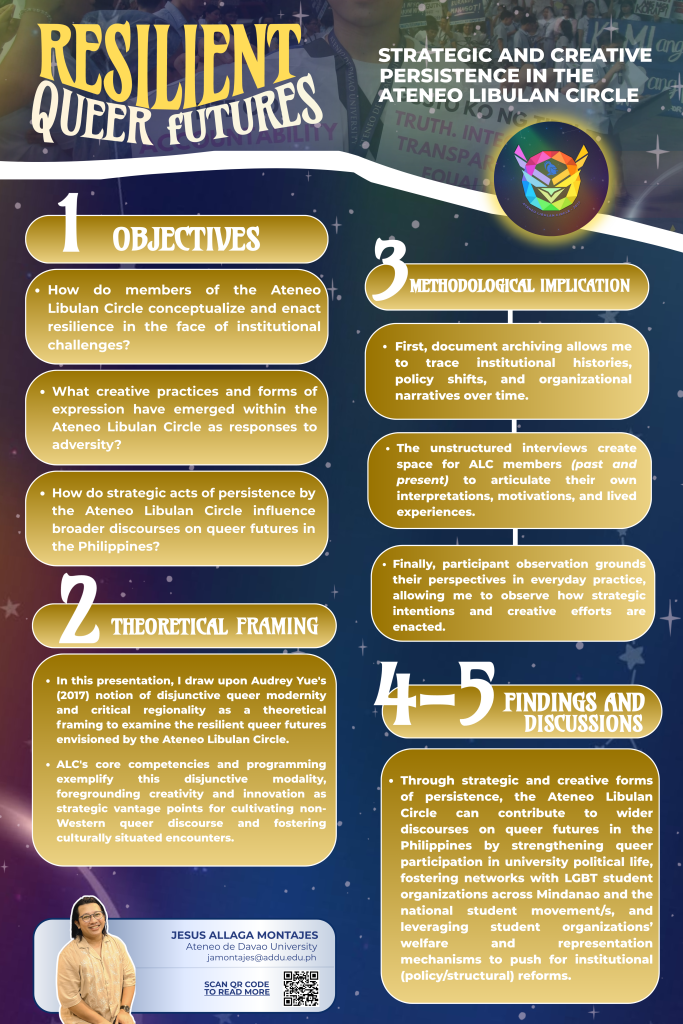
Resilient queer futures: Strategic and creative persistence in the Ateneo Libulan Circle
Jesus Allaga Montajes
The Ateneo Libulan Circle (ALC) is a dynamic socio-civic organization within Ateneo de Davao University (AdDU), founded in 2017, resolutely committed to advancing the rights, dignity, and holistic welfare of the LGBTQIA+ community. With a robust and intersectional mandate, ALC endeavors to cultivate a university culture anchored in equity, inclusivity, and non-discrimination principles. Central to their mission is the critical engagement with discourses surrounding Sexual Orientation, Gender Identity, and Expression (SOGIE). Through advocacy, education, and community-building, ALC seeks to deepen institutional and societal understanding of gender diversity, while challenging normative structures perpetuating marginalization. The name “”Libulan”” is emblematic of ALC’s decolonial ethos. Rooted in Visayan mythology, Libulan refers to a moon deity venerated in pre-colonial Philippine societies, where gender fluidity was accepted and revered. Folkloric accounts suggest that devotees, often men, would cross-dress and grow their hair long in ritual homage to the moon god, reflecting a sacred recognition of gender variance. By reclaiming this narrative, ALC affirms the cultural and spiritual legitimacy of queer identities, situating ALC’s advocacy within a broader historical and mythopoetic framework.
In this presentation, I draw upon Audrey Yue’s (2017) notion of disjunctive queer modernity and critical regionality as a theoretical framing to examine the resilient queer futures envisioned by the Ateneo Libulan Circle. Yue’s interpretive articulation of disjunctive queer modernity is marked by fragmented, non-linear, and regionally contingent expressions of queerness in Asia. It offers a critical lens through which to understand ALC’s praxis as both a response to and a reimagining of queer subjectivities beyond Western paradigms. ALC’s core competencies and programming exemplify this disjunctive modality, foregrounding creativity and innovation as strategic vantage points for cultivating non-Western queer discourse and fostering culturally situated encounters. Through its initiatives, ALC resists hegemonic narratives and constructs alternative epistemologies rooted in local knowledge, affective labor, and intersectional solidarity.
One of the most salient manifestations of this framework is ALC’s commitment to LGBTQIA+ empowerment and literacy, as evidenced by its flagship programs. The Bulan ng Katitikang LGBTQ+ MoonLit (LGBT+ Literary Fest) and the Krayola Night in 2018 celebrated queer literary production as a form of cultural resistance and creative exchange. From 2019 to 2021, ALC launched a series of campus dialogues/critical conversations and webinars interrogating gay discourse amid political dissent, advocating for gender-fair education, and HIV/AIDS, among others, thereby situating queer pedagogy within a far-reaching struggle for democratic participation. Its Pride iterations—Malaya in 2019, Say My Name in 2020, Tuloy Ang Laban: Beyond Labels in 2021, Malayang Titindig in 2022, and Light Years Ahead in 2025 have embodied futurist imaginaries that challenge normative temporalities and envision emancipatory queer horizons. Through these interventions, ALC operationalizes Yue’s disjunctive queer modernity not merely as a theoretical abstraction but as a lived, evolving praxis. It affirms the potential of critical regionality to generate resilient, context-sensitive queer futures that are attuned to the complexities of local histories, identities, and aspirations.